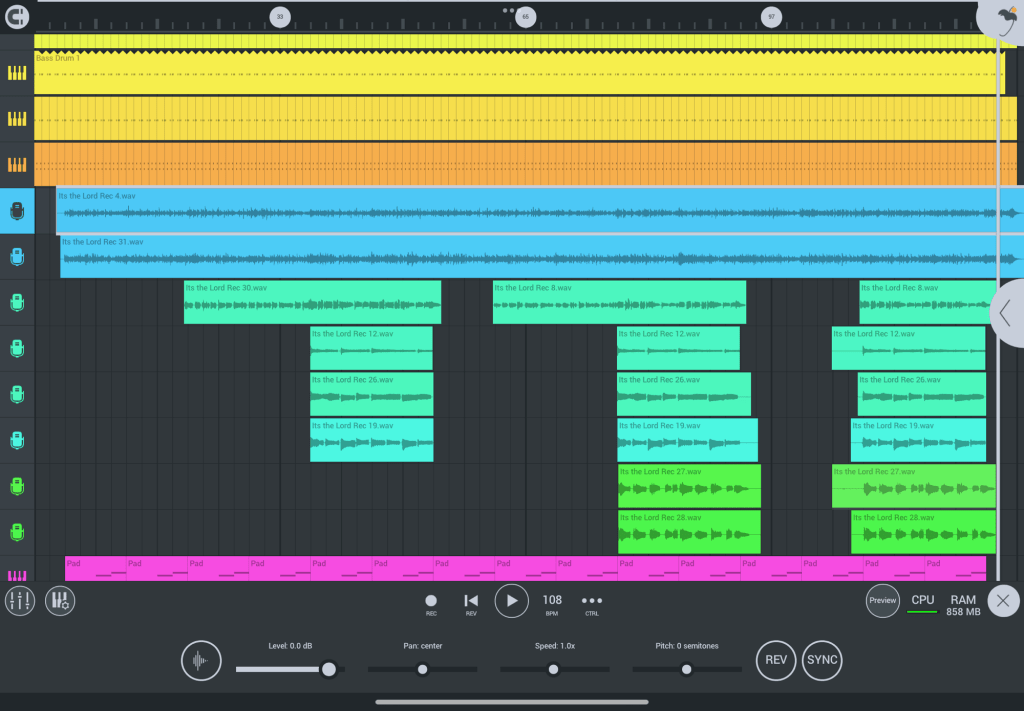
Hey everyone! This is sort of a musical diary entry because right now things are getting serious with almost every aspect of my life, it just takes a little bit of work before I can reap the benefits of all the hard work I’ve done in life.
Let’s get into it.
Creating demos
So when I sent in the song that got recognized by the record label recently, it wasn’t a complete song.
And don’t get me wrong, demos don’t have to be fully produced songs.
Demos can literally just be a guitar and voice. Which is exactly what I did for the first few demos I created.
However, I started doing some more research on demos and demo creation and even though you can send demos out like that, sometimes you do want to fully produce or even partially produce the song.
I mean the bare minimum that it’s really saying is that you want to do a rough mix on some of the songs that you’re sending out to record labels.
So today, I’m going to go over how I made the most recent demo.
Let’s get into it.
The way that i start
So If I’m making a demo, I like to start with a groove of some sort.
It could be a guitar, it could be the bass, it could be the drums.
However, for most of the time, I literally just start a simple in pocket groove with the drums, I will layer the drums however I want to layer it.
Usually if I’m in a rush to get a demo out, I will only layer the bass with 2 kick drums and have the snares layered twice as well.
But if I have more time and I want to take more time on the demo then I will add claps and more snares to the drum kits.
Of course first I figure out the tempo and I write the songs first but for the purpose of this blog post, I’m only going to talk about production elements.
Recording the acoustic parts
After I make a simple drum groove, I will then record the guitars and voice.
Depending on the songs, this is usually where I spend most of my first production day at.
With this previous demo that I just sent in, it literally took me like 3 or 4 hours to record the guitars and another 3 or 4 hours to record the main vocals and the backing vocals.
Yeah it can be a trip.
Now they say that the proper way to make a song is to record and produce the song first so that means adding pianos, synthesizers, bass, pads, etc. first and then mix.
However, if you’re really good, you will do both at the same time.
I’m not saying I’m good, but like I do pick up on mixing fixes that I can do while I’m producing the song.
So while I’m producing, I will add reverb or adjust volumes or re-track certain elements, I guess that’s why when I record vocals and guitars, it takes me so long because I will admit that I do add some mixing effects.
Layer, Layer, and layer
At this point, I will add usually some layers with pads and synthesizers. Just to start kinda giving it some direction and some more emotional feel to it.
Sometimes when I add these layers, I can kinda hear how I want some background vocals to sound.
Sometimes. I can kind of make like a round with the vocals other times I just layer the vocals with each other.
There is a saying in the music industry, that if you want a song to sound emotional, then add the third of the note you’re singing.
So, I’ve been trying to add a third into every vocal line that I do, However, I’ve gotten out of the practice of harmonizing with different notes so It’s a little difficult for me to do right now,
I still make it work though.
And then of course to make the note sound thick, you layer that note as well.
So say for example if you’re singing a C note
Layer that C note with another C note same octave or different octave depends on what you want and then layer those two notes with an E note and then layer that E note with another E note depending on what you want again, same octave or different octave.
You see now why producers take up like 40 or 50 tracks now to make one song
Lastly, some production effects
These effects are different than mixing effects.
This is the simplest way that I can explain production effects.
Imagine in a Gangster rap song, and you hear the gunshots or maybe a car drive by or maybe the rain in the background.
It’s those noises in the background that you hear in songs that just bring the song to life.
It can be any array of sounds both musical and non musical.
Usually when you try and add production effects, you really need to know how to chop up samples.
Which you can learn on YouTube.
I literally one time just YouTubed how to use Studio One Sampler because at the time the DAW that I was using was Studio One, and it literally showed me how to use a Sampler and how to shape sounds the way you want them.
Now lastly
Lol, this is seriously the last things that I do, I literally finish the mix and master.
If you don’t know how to mix, I’m not going to go over how to mix right here because that’s an animal all on it’s own and it would take me literally days to go over how to use the mixing tools needed to mix a great song.
Just know that 90% of all of the songs you’ve ever listened to has 5 effects.
And that’s Reverb, Delay, Saturation, EQ, and Compression.
And Master, I’ll let you figure it out how I do it. LOLOL
Broadcast

I sure hope that I have been an inspiration and a hope to you all. Please remember to pray, read your bible, go to church, and love God above all else. Like, comment, share, subscribe, and I will see you all next time.
If you want to go to heaven, then believe in Jesus and you will go to heaven. (John 3:16)
Thank you all for listening in on this blog post.
German Gonzalez, signing out!
 Greater Christianity
Leave a comment