Which Technology Is Essential for Musicians? 12 Important Tools Every Musician Should Have
Technology has become one of the most important parts of being a successful musician. Whether you are a beginner learning guitar, an independent artist recording original songs, a Christian musician sharing your faith through music, or a professional performer, technology can help you improve your skills, create better music, and reach a larger audience.
In today’s music industry, musicians no longer have to depend entirely on major record labels, expensive recording studios, or traditional radio stations to share their work. With the right technology, independent musicians can record songs, produce music, distribute albums, build websites, promote their work, and communicate with listeners around the world.
However, having access to technology is not enough. Musicians must understand which tools are valuable and how to use them effectively. Purchasing expensive equipment does not automatically make someone a better musician. The goal should be to invest in technology that improves your musical abilities, makes your creative process easier, and helps you build a sustainable music career.
Here are 12 essential technologies that every modern musician should consider.
1. A Reliable Computer or Laptop
One of the most important pieces of technology for a modern musician is a reliable computer. A computer can serve as the foundation of your music career because it allows you to record, edit, produce, organize, and distribute music.
Musicians can use computers to accomplish several important tasks, including:
- Recording original songs.
- Editing vocal and instrumental recordings.
- Producing beats and instrumental tracks.
- Writing lyrics and organizing songwriting ideas.
- Creating promotional videos.
- Designing album covers and promotional graphics.
- Managing websites and social media accounts.
- Distributing music through digital platforms.
You do not necessarily need an expensive computer to accomplish these things. A reasonably powerful laptop or desktop can provide everything you need to begin developing your music.
When purchasing a computer, consider its processing power, memory, storage capacity, and compatibility with your preferred recording software.
The Institution of Sound and Music (ISM) identifies a capable computer as one of the foundational pieces of equipment for recording music at home. Its recording guide also discusses the importance of sufficient memory and storage for handling music projects.
Source: The ISM – Essential Equipment for Recording Music.
2. Digital Audio Workstation (DAW)
Another essential technology for musicians is a digital audio workstation, commonly called a DAW.
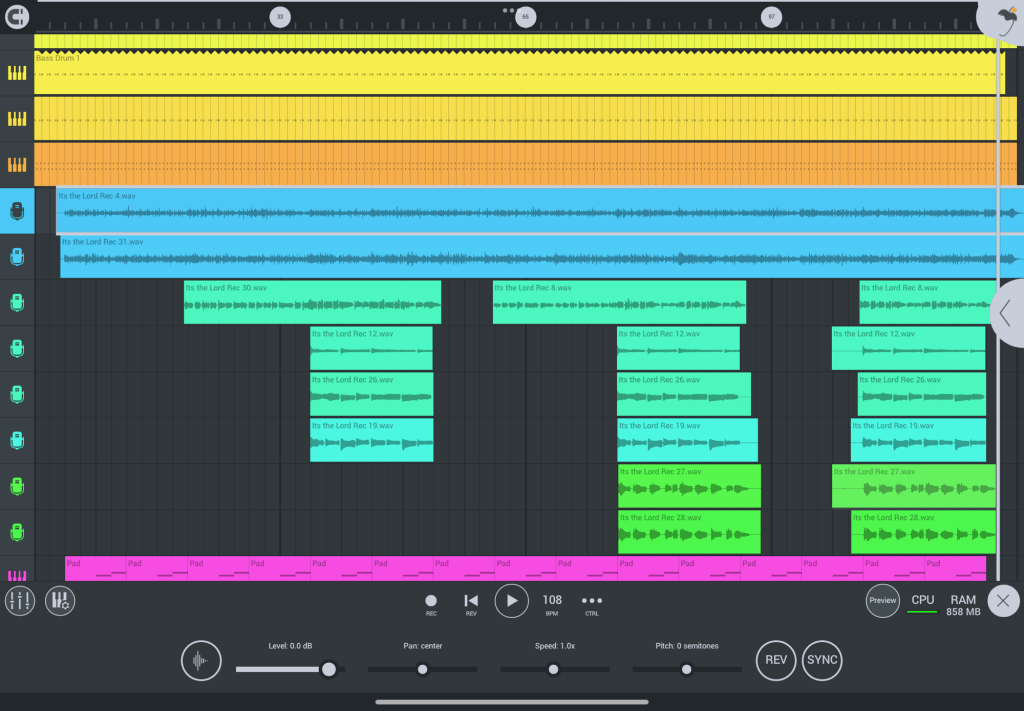
A DAW is software that allows you to record, edit, arrange, mix, and produce music. It essentially turns your computer into a recording studio.
Some popular DAWs include:
- GarageBand.
- Logic Pro.
- Pro Tools.
- Ableton Live.
- FL Studio.
- Reaper.
- Cubase.
Each program has different features, advantages, and learning curves. Some are particularly useful for electronic music production, while others are popular for recording live instruments, vocals, and full bands.
For example, a Christian singer-songwriter could use a DAW to record acoustic guitar, add bass, create drum arrangements, record vocals, and mix everything into a complete song.
A DAW also allows you to experiment with different sounds. You can adjust volume levels, change the arrangement, add reverb, use equalization, and improve the overall presentation of your recordings.
Perhaps one of the greatest advantages is that you can produce music without renting an expensive professional recording studio.
You should learn how to use at least one DAW effectively. Instead of constantly switching between different programs, become comfortable with one and develop your production skills.
Source: The ISM – Essential Equipment for Recording Music.
3. An Audio Interface
An audio interface is another important piece of technology for musicians who want to record music at home.
An audio interface connects microphones and musical instruments to your computer. It converts analog audio signals into digital audio that recording software can process.
For example, if you play electric guitar, you can connect your guitar to an audio interface and record directly into your DAW. You can also connect microphones to record vocals, acoustic guitars, and other instruments.
Many audio interfaces offer multiple inputs, allowing musicians to record more than one instrument or microphone simultaneously.
When purchasing an audio interface, consider how many inputs you need, whether you require phantom power for a condenser microphone, and whether the device is compatible with your computer.
You do not necessarily need an expensive interface. A basic two-input interface can be sufficient for a singer-songwriter recording vocals and guitar.
An audio interface is especially valuable for independent musicians because it gives them the ability to create recordings without depending on an outside studio.
Source: Audient – What Is an Audio Interface and Do I Need One?.
4. A Quality Microphone
A microphone is essential for musicians who want to record vocals, acoustic instruments, podcasts, interviews, or promotional content.
If you are a singer-songwriter, having a dependable microphone can make a significant difference in your ability to produce music.
There are two common types of microphones worth understanding: dynamic and condenser microphones.
Dynamic microphones are often durable and useful for live performances, handheld vocals, and recording loud sound sources.
Condenser microphones are generally more sensitive and are commonly used for studio vocals and acoustic instruments.
The microphone you choose should depend on what you intend to record.
For example, a Christian vocalist recording songs in a home studio may benefit from a condenser microphone, while a musician performing live at a church may prefer a dynamic microphone.
However, purchasing an expensive microphone does not guarantee a great recording. Microphone placement, room acoustics, vocal performance, and recording technique are also important.
Shure’s educational guide explains that microphone selection and placement have a significant influence on the sound of an acoustic recording. It also recommends experimenting with microphone positions to achieve the desired sound.
Source: Shure – Microphone Techniques for Recording.
5. Studio Headphones and Studio Monitors
Musicians need reliable listening equipment to evaluate the quality of their recordings.
Studio headphones and studio monitors are two important tools that help musicians hear their music accurately.
Studio headphones are particularly useful when recording vocals because they allow you to listen to instrumental tracks while singing without sending as much backing-track sound into the microphone.
They are also useful for identifying details that may be difficult to hear through ordinary consumer headphones.
Studio monitors are speakers designed to provide a more accurate representation of recorded audio. They allow musicians to evaluate their mixes and identify problems with volume, frequency balance, and other aspects of sound.
For example, you might discover that your guitar is too loud in the mix or that your vocals need more clarity.
If you are just starting out, a decent pair of studio headphones may be enough. You can purchase studio monitors later as your recording skills and budget improve.
Remember that your goal is to create music that sounds good on different playback systems, including headphones, car speakers, phones, and home stereo systems.
Source: The ISM – Essential Equipment for Recording Music.
6. MIDI Keyboards and Digital Instruments
Another valuable technology is a MIDI keyboard.
MIDI stands for Musical Instrument Digital Interface. It allows electronic musical instruments and compatible software to communicate musical performance information.
A MIDI keyboard can help musicians create melodies, chord progressions, bass lines, drum patterns, and instrumental arrangements.
For example, a guitarist who primarily understands guitar chords can use a MIDI keyboard to experiment with piano arrangements and orchestral sounds.
Many DAWs include virtual instruments, allowing you to play piano, synthesizers, strings, drums, and other sounds without purchasing every physical instrument.
MIDI technology can also help songwriters experiment with musical ideas that might otherwise be difficult to produce.
You do not have to be an accomplished piano player to benefit from MIDI. Even a small keyboard can help you develop musical creativity and explore new arrangements.
This technology is particularly useful for independent musicians who want to produce complete recordings with limited resources.
Source: The ISM – Essential Equipment for Recording Music.
7. A Smartphone and Video Recording Equipment
A smartphone is one of the most useful technologies a musician can own.
Musicians can use smartphones to record performances, create promotional videos, communicate with fans, manage social media, take pictures, and capture songwriting ideas.
You can even use your smartphone to record a quick acoustic performance and share it online.
Consider how valuable this can be for an independent musician.
Instead of waiting until you have enough money to produce an expensive music video, you can begin creating short performance videos with your smartphone.
You can record yourself playing guitar, singing original songs, explaining your songwriting process, or discussing the inspiration behind your music.
Additional equipment can improve your videos. A tripod can keep your phone steady, while an inexpensive lighting setup can make your recordings look more professional.
You can also use video-editing applications to add captions, transitions, titles, and other effects.
For Christian musicians, video technology creates opportunities to share encouraging messages, worship performances, testimonies, and original Christian music.
The important thing is to consistently create content that gives people a reason to discover your music.
8. Video-Editing Software
Video-editing software is another important technology for musicians.
Music promotion has changed significantly because of the growth of online video platforms. Musicians are no longer limited to promoting themselves through radio interviews, printed advertisements, and live performances.
They can create their own promotional content and distribute it online.
Video-editing software allows you to:
- Create music videos.
- Edit live performances.
- Produce lyric videos.
- Create promotional advertisements.
- Add subtitles and captions.
- Combine multiple video clips.
- Add transitions and visual effects.
- Create short-form videos for social media.
Some popular video-editing programs include DaVinci Resolve, Adobe Premiere Pro, CapCut, and Final Cut Pro.
You do not need to become a professional filmmaker. However, learning basic video editing can make you a more resourceful musician.
For example, you could record yourself performing an original Christian song, edit the footage, add the song title, and publish the video on YouTube.
You could also create several short clips from one performance to promote the same song across different social media platforms.
Video editing is particularly valuable because it is another skill you can develop alongside your musical abilities.
9. A Website and Content Management System
Every serious musician should consider having a website.
Social media platforms are valuable, but musicians should not depend entirely on them to establish their online presence.
A website gives you a central location where people can learn about your music, read your biography, listen to your recordings, watch videos, find upcoming performances, and contact you.
You can also use your website to publish articles, share songwriting advice, promote merchandise, and build an email list.
Platforms such as WordPress make it possible to create a website without having extensive programming knowledge.
A musician who regularly publishes useful content can also use search engine optimization (SEO) to help people discover their work through search engines.
For example, a Christian musician could write articles about songwriting, Christian music, guitar playing, music production, and the challenges of being an independent artist.
These articles can attract readers who may eventually become listeners, followers, and supporters.
Your website should include several important elements:
- A professional biography.
- Links to your music.
- Videos of your performances.
- Social media links.
- Contact information.
- An email subscription option.
- Information about upcoming projects.
Your website is more than a digital business card. It can become an important part of your long-term music career.
10. Social Media and Music Distribution Platforms
Social media and digital music distribution platforms are essential technologies for independent musicians who want to reach listeners.
In previous generations, musicians often depended on record labels and traditional distribution companies to get their music into stores. Today, independent artists have more opportunities to distribute their recordings digitally.
Music distribution services can help artists make their songs available on platforms such as Spotify, Apple Music, and other streaming services.
Social media platforms also allow musicians to communicate directly with potential listeners.
Some useful platforms include:
- YouTube for music videos and live performances.
- Facebook for community building and music promotion.
- Instagram for pictures, short videos, and artist updates.
- TikTok for short-form music content.
- X for networking and communicating with other musicians.
The key is to understand that every platform serves a different purpose.
For example, YouTube can help people discover your music videos, while Facebook can help you maintain relationships with people who already follow your work.
You should also consider using the artist tools offered by streaming services.
Spotify for Artists allows musicians to manage their artist profiles, promote music, pitch unreleased songs to playlist editors, and access information about their listeners and streaming performance.
These tools can help you understand which songs are performing well and how people are discovering your music.
Sources:
11. Cloud Storage and Data Backup Technology
One technology that musicians sometimes overlook is cloud storage and data backup.
Imagine spending several months writing, recording, and producing an album. You finally finish your recordings, only to discover that your computer has stopped working and your music files are gone.
Losing your recordings, lyrics, instrumental tracks, and promotional materials could be devastating.
This is why musicians should develop a reliable backup system.
Cloud storage services allow you to store important files online so that you can access them from different devices.
Some commonly used services include:
- Google Drive.
- Dropbox.
- Microsoft OneDrive.
- Apple iCloud.
You should also consider purchasing an external hard drive to maintain another copy of your important files.
The Cybersecurity and Infrastructure Security Agency (CISA) discusses the 3-2-1 backup strategy. This approach recommends keeping three copies of important data, using two different types of storage, and keeping one copy offsite.
Musicians can apply this strategy to protect their recordings and creative work.
For example, you could maintain your original music files on your computer, another copy on an external hard drive, and a third copy in cloud storage.
It is also important to organize your files. Create separate folders for songs, lyrics, album artwork, music videos, and promotional materials.
Protecting your music is just as important as creating it.
Source: CISA – Data Backup Options.
12. Music Applications for Practicing and Improving Your Skills
Technology is not just useful for recording and promoting music. It can also help musicians become better at their craft.
There are numerous applications available that can help you improve your musical abilities.
For example, musicians can use:
- Digital tuners to tune their instruments.
- Metronome applications to improve timing.
- Chord applications to learn new chord progressions.
- Ear-training applications to recognize musical intervals.
- Music theory applications to understand scales and harmony.
- Songwriting applications to organize lyrics and musical ideas.
A guitarist can use a tuner to make sure their instrument is properly tuned before practicing.
A metronome can help a drummer develop better timing or help a guitarist improve their ability to play complicated rhythms.
Music theory applications can also help musicians understand concepts such as major scales, minor scales, chord construction, and key signatures.
You can even use recording applications to record your practice sessions and listen back to identify areas that need improvement.
Technology should complement your musical education, not replace it.
You still need to practice, develop discipline, study music, and gain experience performing with other musicians.
However, using the right applications can make your practice sessions more productive.
Why Musicians Should Embrace Technology
Technology has created opportunities that were much more difficult for independent musicians to access in previous generations.
A musician can now record an entire song at home, create a music video, design album artwork, publish a website, and distribute music internationally without needing a major record label.
This does not mean that technology guarantees success.
You still need to write good songs, develop your musical abilities, build relationships, perform, and consistently work toward your goals.
However, technology can help you accomplish these things more efficiently.
Consider a Christian musician who wants to share the Gospel through original music.
That musician can use recording software to produce songs, video-editing software to create music videos, social media to share performances, and a website to communicate with listeners.
Technology can become a valuable resource for reaching people with a positive message.
It can also help you become more independent. Instead of relying on other people to handle every aspect of your music career, you can develop skills that allow you to accomplish more on your own.
The most successful approach is to identify which technologies directly support your goals and learn how to use them effectively.
How to Choose the Right Technology on a Budget
One mistake musicians make is believing that they need to purchase every piece of equipment available.
You do not need a $10,000 recording studio to start making music.
You also do not need the newest computer, the most expensive microphone, or every video-editing application.
Instead, begin with the technology that addresses your most immediate needs.
Here is a practical purchasing priority for an independent musician:
Technology
Priority
Computer or laptop
Essential for computer-based production
DAW software
Essential for recording and producing
Microphone
Essential for recording vocals and acoustic instruments
Audio interface
Important for recording instruments and microphones
Headphones
Essential for monitoring recordings
Smartphone
Highly useful for content creation
Video-editing software
Important for promotion
Website
Important for establishing an online presence
Cloud storage
Important for protecting creative work
MIDI keyboard
Optional, depending on musical style
Studio monitors
Valuable as your recording setup grows
Music applications
Useful for practice and development
You can start small and gradually expand your equipment as your skills and financial resources improve.
For example, a singer-songwriter could begin with a laptop, an affordable DAW, a microphone, an audio interface, and headphones.
Later, that musician could purchase studio monitors, a MIDI keyboard, additional microphones, and more advanced recording equipment.
The important thing is to avoid spending money on technology that you do not understand or will not use.
Conclusion: Technology Can Help You Become a Better Musician
Technology has become an important part of the modern music industry. Whether you are an independent musician, a songwriter, a guitarist, a vocalist, or a music producer, having access to the right technology can make a significant difference in your development.
Computers, recording software, microphones, audio interfaces, headphones, smartphones, video-editing applications, websites, and social media platforms can all help you improve your music and reach more people.
However, remember that technology is a tool. It cannot replace creativity, discipline, dedication, musical knowledge, or the passion required to become a better musician.
You should continue developing your instrumental abilities, studying music theory, writing songs, practicing regularly, and learning from other musicians.
If you are a Christian musician, remember that technology can also be used as a resource to glorify God. You can use your equipment, recordings, websites, and online platforms to share encouraging messages and create music that points people toward Jesus Christ.
Do not become so focused on purchasing equipment that you forget why you started making music in the first place.
Learn to use the resources available to you. Become knowledgeable about technology, develop new skills, and take advantage of the opportunities available to independent musicians.
You do not have to own everything to get started. You simply need to make the most of what you have.
The right technology, combined with hard work, creativity, and perseverance, can help you take your music to the next level.
Sources and Further Reading
The following sources provide additional information about music recording technology, microphones, audio equipment, and digital music promotion.
- The Incorporated Society of Musicians – Essential Equipment for Recording Music
- Shure – Microphone Techniques for Recording
- Audient – What Is an Audio Interface and Do I Need One?
- Spotify – Spotify for Artists
- Spotify for Artists – Get Started
- CISA – Data Backup Options
Suggested SEO title: 12 Essential Technologies Every Musician Needs to Succeed
Suggested meta description: Discover 12 essential technologies for musicians, including recording equipment, DAWs, microphones, video-editing software, websites, and music promotion tools.


Leave a Reply